Archibald Knox 1864-1933
- Liberty King

- Dec 5, 2025
- 3 min read
Archibald Knox was one of the most influential designers of the British Art Nouveau movement. Born on the Isle of Man as the fifth child of his Scottish parents, he chose not to follow in his family’s footsteps of engineering works, but instead pursued art. As a teenager, he enrolled in the Douglas school of art, where he won prises for his drawing examinations and later received an Art Masters certificate after ten years of study.
In 1892, Knox wrote a study titles “Historic Styles of Ornament Relating to the Manx Runic Crosses’ which was published a year later as the article ‘Ancient Crosses in the Isle of Man’ in the magazine ‘The Builder’.
Moving from his home on the Isle of Man to Fulham in 1897, Knox worked as an art teacher while simultaneously working at The Silver Studio. The Silver Studio were commercial designers for Liberty & Co, with their individual artists producing over 20,000 designs across for Liberty between 1880 and 1963. Knox’s designs were sold through the studio, resulting in Liberty manufacturing pieces from his work whilst crediting them under their own name.

Knox became the primary designer for Liberty & Co, with their Cymric and Tudric ranges being largely attributed to him. In 1900, Knox returned to the Isle of Man but continued sending designs to Liberty, submitting over 400 designs over the four year period he spend there. Items from this period retailed by Liberty are often later attributed to Knox due to being matched with designs bearing Isle of Man pace names. Returning to London in 1904, Knox continued to teach. His students set up the ‘Knox Guild of Design and Craft’ where exhibitions and demonstrations would be regularly held and continued on until its closing in 1937. Knox returned to the Isle of Man in 1913, living there for the remainder of his life. He died in 1933, at the age of 69.
Knox’s designs featured vast amounts of Celtic and Norse artistic inspirations. Expressed through knots and interlacing lines, his early research into medieval Manx crosses showcased a combination of Christian, Celtic and Norse motifs that deeply informed his visual language. Though known mostly for his designs of metal work, Knox also designed terracotta garden ornaments, carpets, wallpaper and fabrics. He painted in watercolour, created many drawings and was even asked to design a memorial stone for Arthur Liberty, the founder of Liberty & Co, at the request of his family, this still stands today in Buckinghamshire.


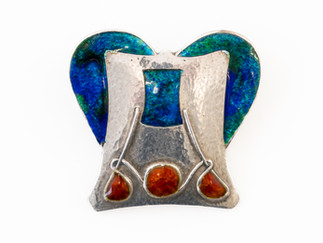
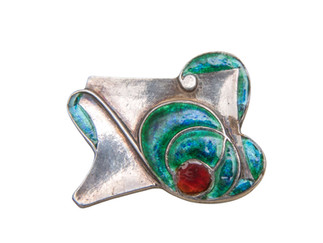
His work is mostly associated with Liberty & Co’s Cymric range of silver and some gold, which launched in 1899. The house would outsource to W H Haseler Ltd for the making of these items, with the early examples being handmade but later adapting to being machine produced and hand finished utilising techniques of casting and stamping. Pieces such as salt and pepper pots, spoons, vases, scent bottles, brooches, clocks, buttons, buckles, dressing table sets and many other items were created. Often featured these typical interlacing lines, enamel work, stones, and knot work so customary of Archibald Knox.
Later, Liberty launched their Tudric range of pewter. These were items of similar designs created and offered as a more affordable alternative to the silver Cymric range. Liberty & Co did not attribute specific designers to help promote the name of Liberty itself rather than the individual maker. Arthur Liberty said “I was determined not to follow the existing fashions, but to create new ones”. His vision helped propel such a unique aesthetic that the Italian Art Nouveau period became known as Liberty Style.
Archibald Knox’s works are highly collectable today. Though many of his designs were never formally attributed during his lifetime, his distinctive style is instantly recognisable. His pieces continue to embody the aesthetic that defined Liberty & Co, and examples at auction regularly draw strong interest and competitive bidding from collectors.