
Queen Victoria's 40 Year Mourning and the Rise Of Mourning Jewellery
- Liberty King

- Aug 6, 2025
- 4 min read
Updated: Aug 14, 2025
Queen Victoria, one of Britain’s longest reigning queens, is known for her 40 year mourning period of her Husband Prince Albert.
Queen Victoria and Prince Albert
The two met in 1836 at Kensington palace as Victoria's Uncle Ernest and his sons Ernest and Albert joined him on his visit. Victoria was immediately taken with Albert, writing in her journal “Albert, who is just as tall as Ernest, but stouter, is extremely handsome; his hair is about the same colour as mine; his eyes are large and blue, and he has a beautiful nose and a very sweet mouth with fine teeth; but the charm of his countenance is his expression, which is most delightful; c’est a la fois full of goodness and sweetness, and very clever and intelligent” -
Enjoying her cousins company so and being terribly upset upon their departure back to Germany, Albert and Victoria stayed in touch through writing, though it seemed as Victoria saw Albert as nothing more than family and a close friend.
After ascending the throne in 1837, Victoria and Albert became closer, turning to Albert for advice and comfort. After two years, Victoria has decided that she wanted to marry him. Writing on the 15th of October 1839 “I sent for Albert; he came to the Closet where I was alone, and after a few minutes I said to him, that I thought he must be aware why I wished them to come here,- and that it would make me too happy is he would consent to what I wished (to marry me); we embraced each other over and over again, and he was so kind, so affectionate; oh! To feel I was, and am, loved by such an angel as Albert”
Victoria proposed to Albert due to a royal tradition that dictated that a reigning monarch can not be proposed to. Their wedding took place on the 10th of February 1840, in the Chapel Royal of St James's Palace. Wearing a simple white dress and an Orange blossom parure, which represented betrothal and chastity, this soon became a staple for Victorian brides to emulate on their special days.


The love story
Their 21 year marriage produced nine children, the first, Princess Victoria, being born nine months after the wedding on the 21st of November. All of Victoria and Albert's children survived into adulthood.
Their love was strong, with Albert creating and designing many gifts for Victoria such as her sapphire and diamond coronet, a charm bracelet with a locket charm for each of her children, a locket with Alberts hair and many others. Albert was known to design jewellery for Victoria, including her oriental Tiara (worn by Queen Elizabeth below)


The pair also embarked on many hobbies and creative outlets together. Albert, very fond of art and science, took up etching with Victoria and the pair would work on pieces together. They took a keen interest in photography with early forms being showcased in Alberts great exhibition. This was an exhibition showcasing the culture and industry, and showed things like the Koh-i-Noor diamond from India and the first modern flushing toilets. In attendance were people like Charles Darwin, Karl Marx, Charlotte Brontë and many other big and influential names. A estimated six million people attended, and it was thought to be Alberts biggest project in his lifetime.
Despite the struggle with Alberts title, with which both Victoria and Albert longed to be ‘King’, this title outranked that of ‘Queen’ which was dismissed by parliament. Victoria fought for Albert to be respected by parliament but did not win the title battle.
Their marriage was thought to be happy, a true love match with passion and genuine affection. They enjoyed family traditions like decorating Christmas trees and Albert was Victorias most trusted advisor.

Albert's death and mourning
Alberts death on the 14th of December 1861 was devastating to both Victoria and the whole of Britain. In Victorias diary the day before his death she writes “oh! How I prayed, that he might be spared to me!”. Victoria did not write in her diary again that year.

This launched Victoria into a period of mourning which lasted the remainder of her life. She writes on the 2nd of January 1862 “miss my beloved one’s assistance terribly”

Queen Victorias favourite pieces
Victoria's mourning period was characterised by her black attire, and her withdrawal from public life which lasted for over ten years. This damaged her public image greatly, with the attitude that she was paralysed with grief and that it made her incapable of doing her job. Mourning pieces included black pearls, memorial rings with portraits, hairwork lockets, black enamel pieces, jet and onyx. The queen also had a new crown made in 1870 that fit over her widow's cap.


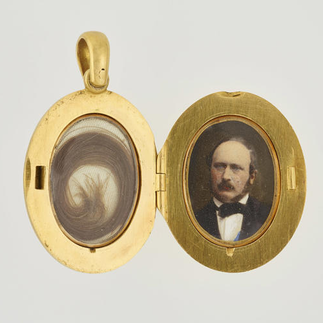
How Queen Victoria spurred the trend
This created a huge trend across Britain. Queen Victoria was already idolised, with her photographed portrait being handed out to the public making her image widely accessible. She was a focal point of Imperial pride due to the expansion of the British Empire at the time and took an active interest in these affairs. Her large family was an inspiration to the public, and her appearances with Albert in ordinary clothes made her appealing to the middle and lower classes. Therefore, this sudden drop into mourning with a complete overhaul of behaviour and fashion, it is no surprise that these fashions were carried through to the public.

The origins of Mourning jewellery
It must be said, however, that mourning jewellery was not created by Victoria, but only popularised. Mourning jewellery dates as far back as the 16th Century, Victoria only created the trend and re-ignited the movement of jewellery to be commonly worn.
All imagery not otherwise credited Supplied by Royal Collection Trust / © HM King Charles III


